Identification
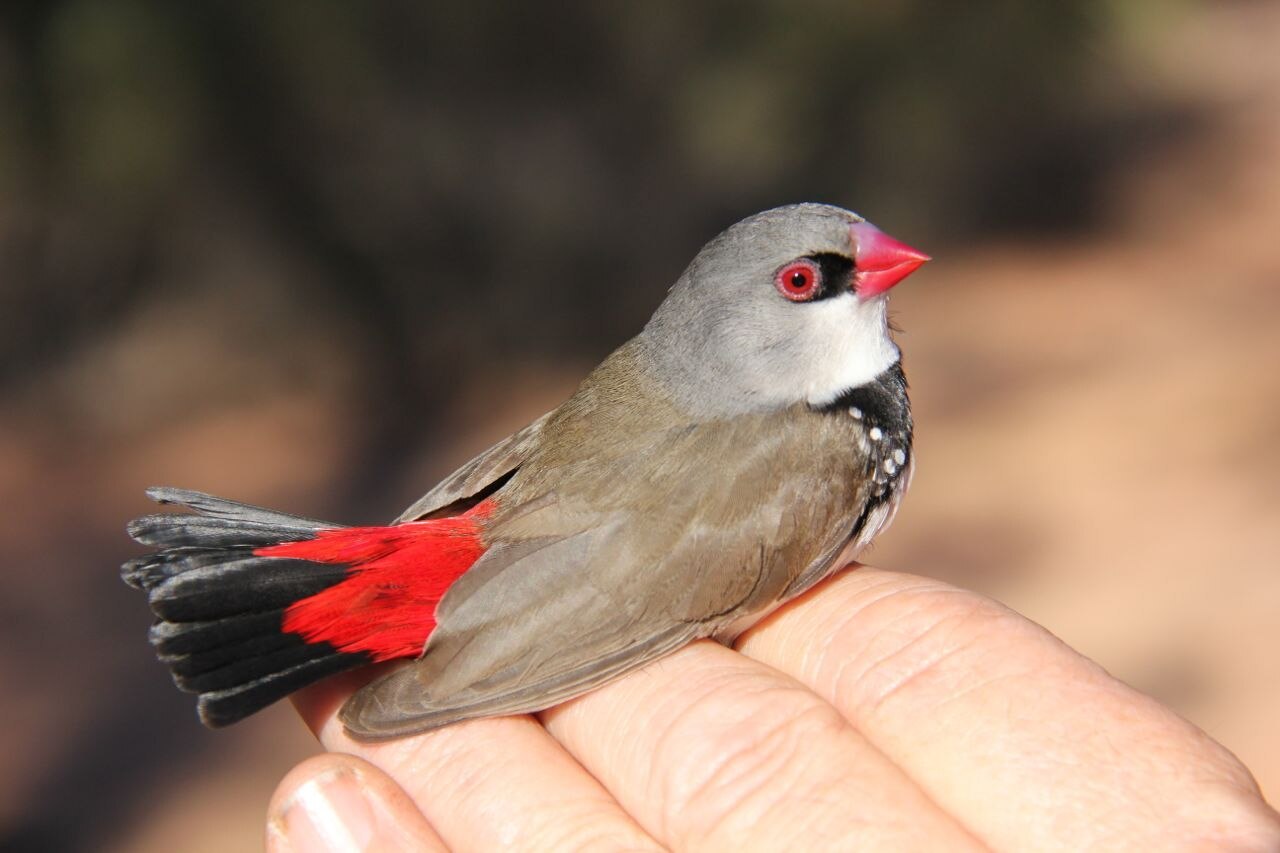
An ash-brown and grey finch with a white belly, broad black breast band, white-spotted black flanks and a crimson rump. The coral-red bill and eye ring complete the adult pattern; young birds have a darker bill.
Male & female
Females resemble males closely and may be smaller, but size alone is not dependable. Assess fully mature birds with behavioural and validated evidence; a muted juvenile or a colour mutation should not be sexed by adult colour rules.
Nature & behaviour
Native to south-eastern Australian grassy woodland and open country with scattered trees. It commonly feeds on the ground, so feeding layout must provide clean low access as well as elevated retreat and exercise routes.
Cages & aviaries
Use a substantial sheltered flight with clear landing space, dry ground-feeding trays and screened nesting supports. Its bold appearance is not evidence that a small cage or exposed nest site meets its behavioural needs.
Diet & feeding
Natural food includes ripe and partly ripe seeds, with occasional insects and larvae. Supply varied suitable seeds, seeding grasses and an accepted rearing food; distinguish food swallowed from seed husks accumulating in the feeder.
Breeding
Courtship includes a male carrying grass and bobbing near the hen. Both parents contribute to the nest and share incubation and care. The museum gives a five-to-six-egg clutch, twelve-day incubation and around twenty-two days in the nest.
Compatibility
Begin breeding with one compatible pair and observe any companions closely. Do not let a confident bird monopolise cover or seed trays; shared presence at a water point is weaker evidence than successful ongoing access to every resource.
Breeding timeline
Follow the bird, not just the calendar. Published ranges are observation windows; actual parental care and feeding decide the next step.
Clutch size
5–6 Eggseggs; reference onlyIncubation
12 daysdays after sustained incubation; reference onlyFledging
22 daysdays after hatch; reference onlyIndependent feeding
Not establishedNo universal separation age is established. Confirm repeated independent eating and drinking and stable condition while monitoring parental support.
Reference observations are not captive guarantees. Record actual hatch and feeding; never separate a chick solely because a date has arrived.
Sources & image credits