Identification
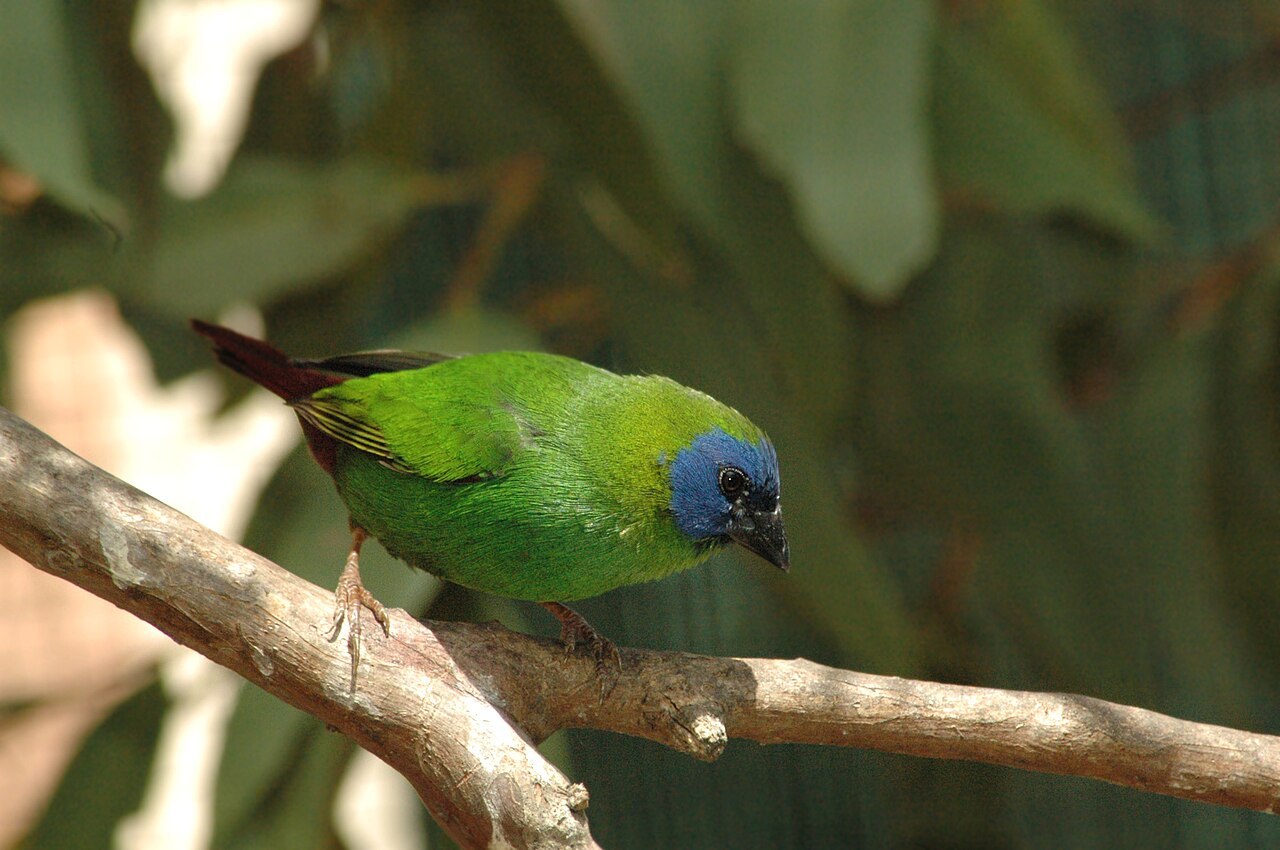
Green body, blue facial mask, red rump/tail and dark bill identify the normal Blue-faced Parrotfinch. Erythrura trichroa must not be confused with Forbes’s true Tricolored Parrotfinch, E. tricolor.
Male & female
Males often show a broader, stronger blue mask, but overlap, age and mutations weaken this cue. Use documented behaviour and validated sexing when selecting a pair.
Nature & behaviour
Ranges across parts of Southeast Asia, New Guinea and Pacific islands, including an Australian population. Habitat and form vary across this broad distribution.
Cages & aviaries
Plan a planted or screened flight with clear movement routes, bathing provision and privacy. Active birds still need fitness monitoring; a cage-breeding account is not approval of every cage size.
Diet & feeding
NFSS recommends varied millets, canary and grass seeds; egg food and insects are used during chick rearing. Verify consumption and hygienic supply before nesting.
Breeding
Parent-rearing is established in the NFSS account. Hill and Pollard describe 4–6 eggs, 13–14 days incubation and fledging around 21 days. Confirm pair acceptance and actual chick feeding rather than enforcing a calendar.
Compatibility
Keep parrotfinch breeding pairs separated to preserve identity and reduce interference. Do not presume different Erythrura species or colour forms should nest together.
Breeding timeline
Follow the bird, not just the calendar. Published ranges are observation windows; actual parental care and feeding decide the next step.
Clutch size
4–6 Eggseggs; reference onlyIncubation
13–14 daysdays from sustained incubation; reference onlyFledging
21 daysdays after hatch; reference onlyIndependent feeding
Not establishedNo automatic separation age is established. Confirm repeated independent eating and drinking, stable condition and continued parental care.
The displayed windows follow the Hill/Pollard breeder account. Bird Kingdom instead describes 4–8 eggs, about 15 days incubation and 21 days to fledging, with another 10–20 days of parental feeding. These differing observations are references, not guarantees or automatic separation dates.
Sources & image credits